

Hello it’s me again!
Without further ado, here’s my drafted list of suggested answers for this year’s Physics 5058 MCQ Paper 1, along with the usual workings, diagrams and explanations to my answers (where applicable).
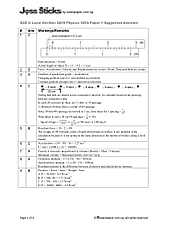
2009 O-Level October/November Physics 5058 Paper 1 Suggested Solutions – click to download
So how did your tikam-tikam go? Do leave a comment if you spot any mistake, typo and/or wish to clarify any of the explanations given. At least I think my typewriting is nicer than my sister‘s A/E-Maths solutions 😉
Good luck for those of you with your remaining papers! As my sister says, FREEDOM IS NEAR!






















32 Comments
曜
日
Thanks for the solutions:D and great web too.
曜
日
For question 4,
Can we use the dots to find the speed instead of the intervals?
20cm = 11 dots
20cm X 11/50 dots (seconds) = 90.9 = 91cm/s
Wouldn't the answer now be B?
曜
日
To bob : u must ignore the first dot so there is actually only ten dots. if u cant understand, u image the thing makes 3 dots per sec, then dist bet each dot is 1cm. the total dist will be 2cm even though there are 3 dots.
曜
日
Sian...
6 wrong liao, is it possible to get an A1?
曜
日
Yes X and Bob, that's why I've written in Q4 that since some dots are common across consecutive interval, so it's safer (at least to me) to calculate based on the 'spacings' between consecutive dots, since we can be sure that the 'spacings' (not dots) will accurately add up to the 20 cm distance.
曜
日
For question 28, when it is discharging, current will flow from positive to negative. ( conventional current ) so when u charging it, current has to flow from negative to positive right? so isn't the answer be B instead? If it were to be A, the diode will block the current, causing an open circuit instead.
sorry for the broken english (:
曜
日
OMG! 5 wrong,i hate the world, i wana jump!
曜
日
hi. i cannot open the pure physics 5058/01 ans. it says, "the file is damaged and cannot be repaired. can something be done about it? can you post the ans at the 'chatter' section? thanks.
曜
日
To Shaun: Don't you think you're being a little too STUCK-UP!! I got 33/40 and I'm still fine with it.. Go ahead and jump if want to..! I despise arrogant people like you..!
曜
日
Hello childlike93, for Qn 28 let's first reproduce my diagram pertaining to option A from the solution set:
Yes you stated correctly what the question says i.e charging "is done by passing a current (from the a.c. supply) through the battery in the opposite direction to that when it (the battery) is discharging." It's important to note that we are talking about conventional current throughout this discussion.
When the a.c. supply is CHARGING the battery, the current flows clockwise (consider it as flowing from -ve to +ve terminal of the battery as you've correctly said) around the circuit (as shown in the left diagram).
The diode allows this current to flow, as the arrow on the diode symbol indicates the direction in which the conventional current can flow.
When the battery is DISCHARGING itself (when it's not being charged since the a.c. supply reverses the direction of its current), the current is supposed to flow in an anti-clockwise direction (from its +ve to -ve terminal as you've correctly said).
However, the diode blocks this current since it's in the opposite direction to the arrow in the diode symbol (see the right diagram) - hence the battery is prevented from discharging and neutralizing the charging process.
In the case of option B, the process is reversed since the diode is reversed i.e. it prevents the a.c. supply's charging current from flowing, while allowing the battery to discharge itself, which is not what the engineer in the question wants to achieve.
曜
日
I agree with zac too. I've only got 23/40 ._. who's worst off?
曜
日
Sorry..I might have been a little too harsh on my words earlier..! I apologise to you( Shaun) for that...
曜
日
But if we're given a real life scenario, EG. qns 28, shouldn't we use the real direction of current instead of the conventional one? Else it wouldn't work.
曜
日
I thought Q17 answer should be C. Since temperature is increasing and volume decreasing, thus pressure is constant.
Also Q21 answer I thought should be A instead of D. If use longer focal length lens, then object will not be at focal point.
曜
日
Bob: Even if we were to use the 'real' direction of an electron current in our circuit, the scenario remains unchanged as we'll then be considering the 'real' direction of the diode, which is opposite to the direction of the arrow in its symbol 😉
Joe: Errr ... for Q17 since PV ∝ T, pressure cannot be constant as temperature increases & volume decreases.
For Q21, try moving the object away from the lens in this little application 😉
曜
日
thank you for your vivid explanation. but then again, i still don't think it's A. My thinking is that AC supply is giving the energy to the battery ( storing as chemical energy) so, if you choose A, current will enter from negative to positive. however, the diode will block the flow of current, thus enable to recharge it.
Again, why when charging, current will flow clockwise.? i thought it should be anti clockwise? ( from negative to positive )
eh.can help me clear my confusion? 😀
thanks !
曜
日
do you have pure biology paper 1 and paper 2 answers?
曜
日
for qn 20
i think the explanation is wrong
even if refraction occurs at P, total internal reflection is still possible at surface Q as long as angle of incident is large enough. the explanation should be the emergent ray bends towards the normal when it should bend away from the normal as light travel from denser to less dense
曜
日
For Q17, for temperature, pressure and volume,shouldn't one of them have to remain constant if 2 other change. (as shown in the textbook???)
**Little Miss Loi, could you please share with the answer for pure chemistry and biology too???
曜
日
I shall address Al's query first (and to take this opportunity as well to elaborate on my reply to Joe last night ... sorry was a bit late) ...
Do note that the relationships between pressure (p), volume (V) and temperature (T) of a gas described in many 'O' Level textbooks involve controlled environments where one of the parameters is (artificially) fixed e.g. take the piston example where a gas is heated.
In Q17, it's stated that:
Now nothing has been said about the pressure, but with the volume actually getting smaller, we know that the faster atoms will hit the 'wall' of the cloud more frequently and with more force ⇒ p increases.
So it's worth noting in this case that p, V and T changes in our galactic hydrogen clouds in Q17. In fact in your A-Level Physics, you'll learn that the only thing that will be constant in all scenarios is its gaseous mass i.e. the k in pV = kT.
曜
日
Thanks Miss Loi. I fully understand it now. 🙂
曜
日
Ok to answer Dan ...
First of all, thanks for pointing out Qn 20. It made me re-look my explanation for this question and I've subsequently amended my explanation to make things clearer (I hope).
Now, about total internal reflection being still possible (assuming refraction has occurred at Surface P) consider the refraction at Surface P in the following diagram ...
Say if we were to reverse the light ray such that it travels out of the (denser) glass at P, angle β < critical angle of the glass-air boundary if refraction occurs here.
And since it's stated that the glass block is rectangular (P // Q), the incident angle at Q will also be β (< critical angle) ⇒ refraction must occur at Q, and the emergent ray will be parallel to the incident ray at P (as shown by the red dotted line).
For total internal reflection to occur at Q, the surface must be sufficiently angled such that angle α is greater than the critical angle, as shown in the following diagram:
As such, I've based my explanation on the impossibility of total internal reflection at Q (given than the glass block is rectangular) which means that the subsequent path of the ray (in solid red in the first diagram) cannot exist.
But of course it's entirely correct too to point out that the emergent ray shouldn't bend towards the normal in the original diagram, maybe this is Cambridge's way to 'make sure' that this path is impossible haha.
曜
日
Hi Miss Loi, i've posted earlier regarding not being able to open 5058/01 (physics paper). can you please do something about it or just post the answers here? please help me because i've been waiting for the answers for a long time already. thanks a lot.
曜
日
Hi sweetue, I'm sorry that I was unable to reply you earlier as I'm currently busy with the rest of the MCQs.
At this moment the best thing I can do is the reproduce the answers as follows:
Q1-5: C D D C B
Q6-10: C A A B C
Q11-15: B C A A B
Q16-20: B B D D B
Q21-25: D D C C B
Q26-30: C D A D C
Q31-35: C D C D A
Q36-40: C B D D D
However the pdf file (with all the diagrams and workings) looks OK on our side. Have you tried to view it on another computer? Which pdf reader (and version) are you using?
曜
日
Nic: I've finally done up my Chemistry & Biology Paper 1 solutions 😉
曜
日
using the application it shows when object moved away from focal length, image becomes smaller, therefore it is focus, since smaller = focus?
so answer should be A?
and if the object falls into smaller than the focal length, then image formed would be virtual and not focused in the case when lengthening focal length of lens.
曜
日
Hi there!
In regards of question 27, for choice A will we get the similar current of 1A ?
曜
日
Hello I'm back! Now to answer the outstanding questions here:
childlike93: Regarding the direction of the charging current, we don't really have to think about how it charges (chemical energy and all) when it's already been defined in the question when it said "This (charging) is done by passing a current through the battery in the opposite direction to that when it is discharging."
We know that the current flows anti-clockwise when the battery discharges (conventional current flows out of its positive terminal). Thus the charging current has to be clockwise.
As mentioned earlier it's easier to consider the conventional current since the diode symbol's 'arrow' is pointing in the direction of the conventional current.
random123: I've taken the liberty to draw out the following diagrams for the options (didn't do option C since it's obvious that a brighter object will not help in focussing its image on the screen:
To focus the image on the screen i.e. what we want are the light rays to converge exactly on the screen. Else it will be blurred.
If you've played around with the application, moving the object away from the lens in Option A will cause the rays to converge somewhere along the principal axis that is nearer to its focal point F, but what we actually need is for them to converge at the screen which is farther away from F.
Moving the screen away from the lens in Option B will obviously make it worse, as shown in the diagram
In Option D, a (typically) thinner lens with a longer focal length causes the rays to bend less and hence converge farther away. Thus by picking an appropriate lens with a longer focal length, we can 'aim' the light rays to converge exactly on the screen.
Anyone notice that this is a classic scenario of myopia aka short-sightedness? The 'screen' is actually your retina!
ds(:: Yes the two (identical) cells connected in parallel in the circuit in Option A will yield the same potential difference across the circuit i.e. the voltage is the same as that of a single cell. Hence the current will still be 1A.
P.S. While the voltage and current is unchanged, do note that connecting cells in parallel actually helps them last longer, since each cell only has to supply a fraction of the 1A current demanded by the lamp. Now you know why the Duracell Bunny can last so long 😉
曜
日
i've got 2 wrong. Not careless but don't know how to do. But my P2's kinda screwed so that balances off.
曜
日
can you plz explain CRO 'cause i never really get it.
曜
日
For Q28 , some books wrote the answer as D . Could you explain why isnt the answer D?
曜
日
@Clara: At first glance D will charge the battery in a similar manner to A BUT will result in a short circuit when the ac current flows anticlockwise, since the diode offers a path of zero resistance which may draw an infinitely high current from the ac supply (a dangerous scenario).
Actually you're more likely to find a capacitor in parallel in a charging circuit to increase its charging efficiency (as shown in this *battery charger circuit) but that's ... errr ... beyond the O Level Physics syllabus.
*ignore the diode for the optional LED indicator - even then there's a 10 kΩ resistor in series to prevent short circuiting 🙂